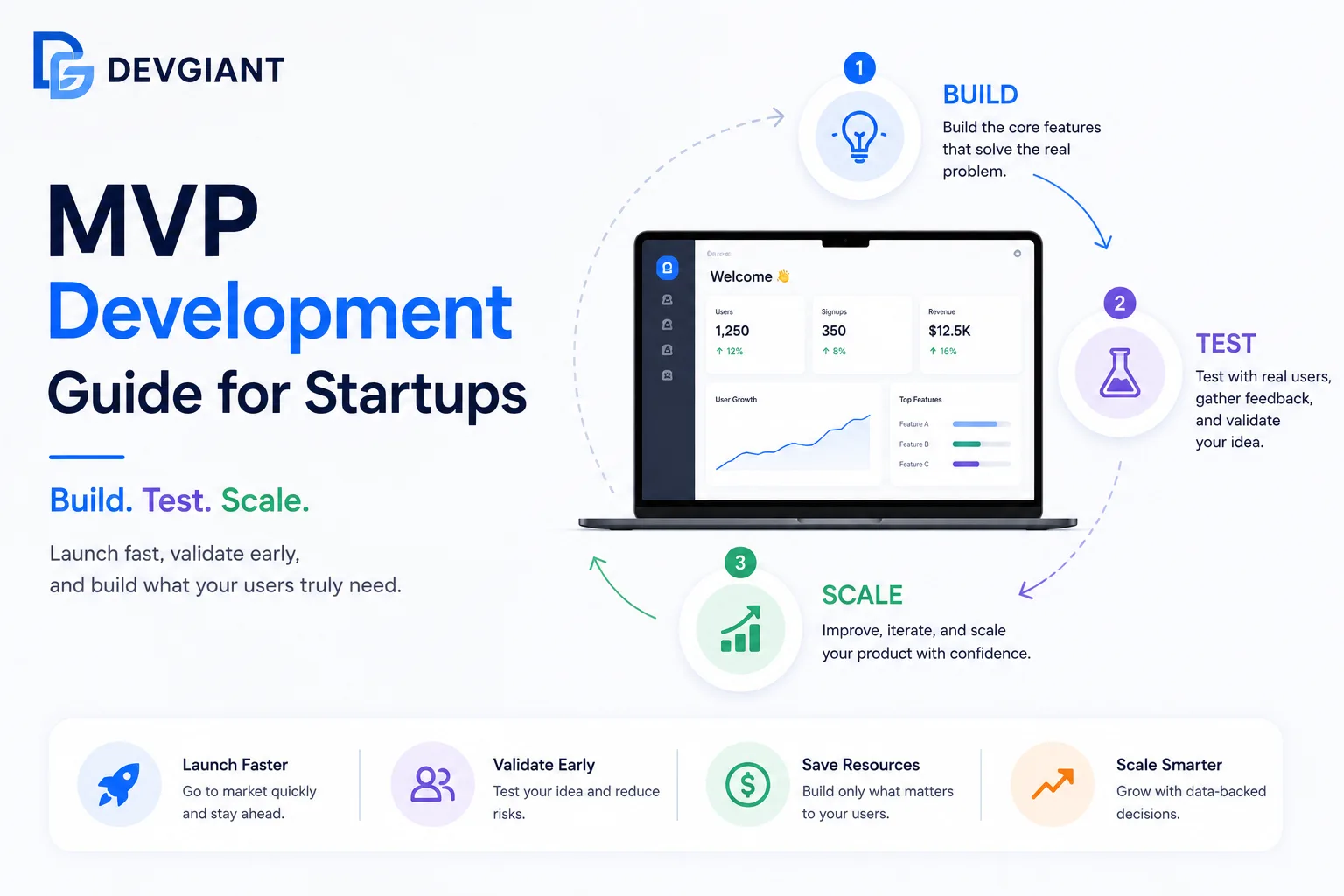
Every startup begins with a bold idea, but turning that idea into a market‑ready product without draining cash or time is the real challenge. An minimum viable product (MVP) lets founders test assumptions, gather real user feedback, and prove traction before committing to full‑scale development. This guide walks you through every phase of MVP development, from concept to launch, and shows how to keep the process lean, data‑driven, and ready for rapid iteration.
1. What Exactly Is an MVP?
An MVP is the simplest version of a product that delivers enough core value to solve a specific problem for early adopters. It is not a “half‑baked” prototype; it is a functional, usable solution that validates a hypothesis about market demand.
Key characteristics
- Core functionality only: Include the essential features that address the primary pain point.
- Rapid delivery: Build quickly to start learning as soon as possible.
- Measurable outcomes: Define clear metrics (e.g., sign‑ups, conversion rate) to gauge success.
- Scalable foundation: Architecture should allow easy addition of features later.
2. Why a Startup MVP Is Non‑Negotiable
Investors, customers, and your own team expect evidence that the product solves a real problem. An MVP provides that evidence while protecting limited resources.
Benefits for founders
- Risk reduction: Validate demand before large‑scale hiring or infrastructure spend.
- Faster fundraising: Demonstrable traction (user sign‑ups, usage data) strengthens pitch decks.
- Customer insight: Early users become a feedback loop, shaping product‑market fit.
- Competitive edge: Enter the market sooner than rivals who wait for a “perfect” product.
3. Step‑by‑Step Blueprint for Building a Startup MVP
3.1 Define the problem and target persona
Start with a concise problem statement. Who suffers from this problem? Create a detailed persona that includes demographics, goals, and pain points. This persona will guide every feature decision.
3.2 Prioritize the core value proposition
List all potential features and rank them using the MoSCoW method (Must‑have, Should‑have, Could‑have, Won’t‑have). Keep only the “Must‑have” items for the first release.
3.3 Sketch user flows and low‑fidelity wireframes
Map out the end‑to‑end journey a user takes to achieve the core outcome. Simple hand‑drawn sketches or tools like Balsamiq are sufficient—no need for polished UI at this stage.
3.4 Choose the right tech stack
For most SaaS MVPs, a combination of a proven backend framework (Node.js, Ruby on Rails, or Django) and a lightweight frontend library (React, Vue, or Svelte) balances speed and scalability. Consider serverless options (AWS Lambda, Firebase) to cut infrastructure overhead.
3.5 Build, test, and iterate
- Develop in sprints: 1‑2 week cycles keep momentum.
- Automated testing: Unit tests for core logic prevent regressions.
- Beta release: Invite a small group of target users, collect qualitative feedback, and track quantitative metrics.
3.6 Launch the MVP publicly
When key metrics (e.g., 100 active users, 20% activation rate) are met, open the product to a wider audience. Use landing‑page tools, email campaigns, and early‑adopter incentives to drive traffic.
4. Selecting the Right Tech Stack for MVP App Development
The technology you choose can either accelerate development or become a hidden cost. Below is a quick decision matrix for common SaaS scenarios.
4.1 Backend considerations
- Node.js + Express: Ideal for real‑time features and JavaScript‑centric teams.
- Ruby on Rails: Fast convention‑over‑configuration; great for CRUD‑heavy apps.
- Django (Python): Strong admin interface and built‑in security.
- Serverless (Firebase, Supabase): Zero‑maintenance databases and auth, perfect for ultra‑lean MVPs.
4.2 Frontend considerations
- React: Large ecosystem, reusable components, good for future scaling.
- Vue: Gentle learning curve, concise syntax.
- Svelte: Compiles to minimal JavaScript, reduces bundle size.
4.3 Database & hosting
- PostgreSQL for relational data with strong integrity.
- MongoDB for flexible document structures.
- Managed services (Heroku, Render) to avoid DevOps overhead.
5. Common Pitfalls and How to Avoid Them
5.1 Over‑engineering
Adding “nice‑to‑have” features delays launch and inflates cost. Stick to the “must‑have” list until you have validated demand.
5.2 Ignoring user feedback
Quantitative data is valuable, but qualitative insights reveal hidden friction. Conduct short interviews or surveys after each beta cycle.
5.3 Poor metric selection
Tracking vanity metrics (e.g., page views) can mislead. Focus on activation, retention, and revenue‑related KPIs.
5.4 Inadequate security
Even a minimal product must protect user data. Use HTTPS, secure password hashing (bcrypt), and follow OWASP guidelines from day one.
6. Measuring Success and Planning the Next Iteration
After launch, treat the MVP as a hypothesis test. Compare actual results against predefined success criteria.
Key metrics to monitor
- Activation rate: % of users who complete the core action.
- Retention (Day 7, Day 30): Indicates product value over time.
- Customer acquisition cost (CAC): Helps evaluate marketing efficiency.
- Lifetime value (LTV): Early estimate of revenue potential.
When metrics meet or exceed targets, prioritize the next set of features based on user requests and business goals. This iterative loop—build, measure, learn—keeps the product aligned with market needs.
Conclusion: Turn Your Vision into a Validated Product Fast
Building an MVP is not a shortcut; it’s a disciplined approach to learning what customers truly want. By defining a clear problem, focusing on core features, choosing a lean tech stack, and iterating based on real data, startup founders can de‑risk their venture and attract investors with tangible traction.
Ready to accelerate your MVP journey? Explore our MVP development services to get expert guidance from concept to launch. Have specific questions or want a custom quote? Get in touch today, and let’s turn your idea into a market‑ready product.