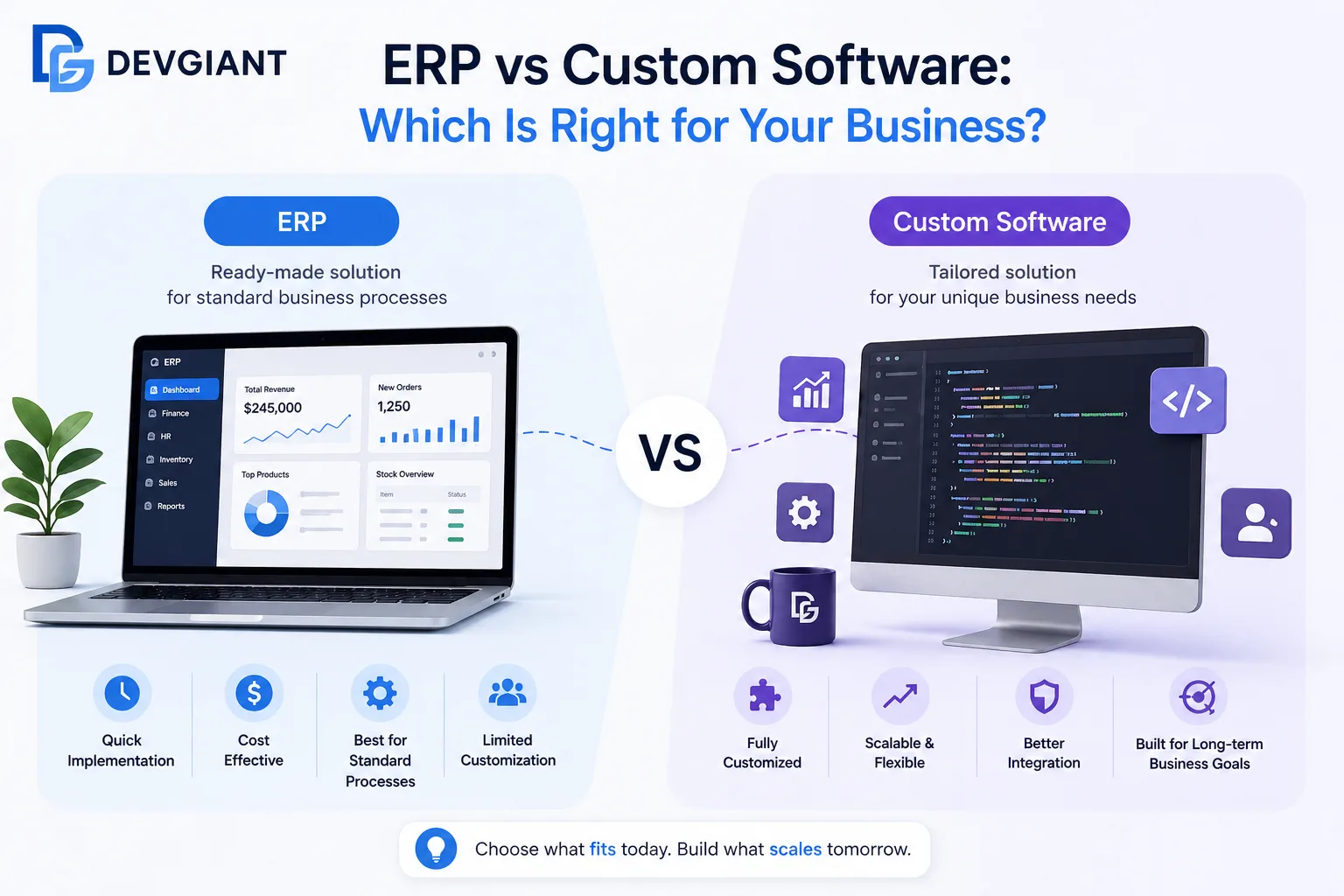
Every growing enterprise faces a pivotal question: should you invest in a ready‑made ERP system or build a custom software solution from scratch? The decision impacts budgets, timelines, and long‑term agility. In this guide we break down the essentials, compare the two approaches side‑by‑side, and give you a practical framework to choose the best fit for your organization.
Understanding ERP Systems
What Is an ERP?
Enterprise Resource Planning (ERP) software is a suite of integrated applications that manage core business processes—finance, human resources, supply chain, manufacturing, and customer relationship management—in a single database. By unifying data, ERP eliminates silos, improves visibility, and supports data‑driven decision making.
Core Modules That Power an ERP
Most ERP platforms offer a modular architecture, allowing you to enable only the functions you need. Typical modules include:
- Financial Management – general ledger, accounts payable/receivable, budgeting.
- Human Capital Management – payroll, talent acquisition, performance tracking.
- Supply Chain & Inventory – procurement, order fulfillment, warehouse control.
- Manufacturing – production planning, shop‑floor control, quality management.
- Customer Relationship Management – sales pipeline, service tickets, marketing automation.
Because the modules share a common data model, information flows automatically across departments, reducing duplicate entry and errors.
Custom Software Explained
Definition and Scope
Custom software is a tailor‑made application built to address a specific set of business challenges. Unlike off‑the‑shelf ERP, it is designed from the ground up to match your unique workflows, data structures, and integration points.
The Development Lifecycle
A typical custom‑software project follows these stages:
- Discovery & Requirements Gathering: Stakeholders map processes, pain points, and success criteria.
- Design & Prototyping: UI/UX mockups and system architecture are created for early validation.
- Development & Testing: Agile sprints deliver functional increments, with continuous quality assurance.
- Deployment & Training: The solution goes live, and end‑users receive hands‑on training.
- Maintenance & Evolution: Ongoing support adapts the software to emerging needs.
This iterative approach yields a product that aligns precisely with your operational reality, but it also requires disciplined project management and a clear budget.
Head‑to‑Head Comparison
Cost & Return on Investment
ERP systems usually involve licensing fees, implementation services, and annual maintenance. While the upfront cost can be high, the predictable expense model and rapid deployment often translate to a faster ROI for standard processes.
Custom software demands a larger initial investment for design, development, and testing. However, if your business has niche requirements that would need extensive ERP customizations, a bespoke solution can be more cost‑effective over the long term because you avoid expensive add‑on modules and perpetual licensing.
Scalability & Flexibility
Modern ERP platforms are built to scale across multiple sites, languages, and regulatory regimes. Their architecture supports thousands of concurrent users and can handle complex multi‑entity consolidations.
Custom applications can be engineered for scalability from day one, but that requires foresight in architecture (micro‑services, cloud‑native design, etc.). Without proper planning, a bespoke system may hit performance bottlenecks as transaction volume grows.
Integration & Compatibility
ERP vendors provide pre‑built connectors for popular CRM, e‑commerce, and BI tools. Integration is often a matter of configuration rather than code, reducing risk.
With custom software you control every integration point. This is advantageous when you need deep, real‑time data exchange with legacy systems or industry‑specific hardware. The trade‑off is that each integration must be coded, tested, and maintained.
Time to Deploy
Because ERP packages come with ready‑made functionality, a typical implementation takes 3–9 months, depending on scope and customization.
Building custom software usually requires 6–18 months, reflecting the need for requirement gathering, development cycles, and user acceptance testing. If speed is critical, ERP often wins the race.
When to Choose ERP vs Custom
Ideal Scenarios for ERP
- Your organization follows industry‑standard processes (e.g., finance, procurement, inventory).
- You prefer a predictable cost structure with vendor‑managed upgrades and support.
- You value a proven ecosystem of partners, extensions, and best‑practice templates.
Ideal Scenarios for Custom Software
- Your business model relies on unique workflows that do not fit standard ERP modules.
Decision Framework
Use the following checklist to evaluate which path aligns with your strategic goals:
- Define core business processes – are they standard or highly specialized?
- Calculate total cost of ownership (licensing, implementation, customization, maintenance).
- Assess integration complexity – how many legacy or third‑party systems must connect?
- Determine time‑to‑value – when does the solution need to be operational?
- Evaluate internal capabilities – do you have a development team that can sustain a custom product?
- Consider future growth – will the solution support multi‑site, multi‑currency, or multi‑language expansion?
For enterprises that need a balanced approach, many vendors now offer hybrid implementation services that combine core ERP modules with custom extensions built to your specifications.
Conclusion & Call to Action
Choosing between an ERP system and custom software is not a binary decision; it’s a strategic trade‑off between speed, cost, flexibility, and long‑term control. By mapping your unique requirements against the comparison points above, you can make an informed choice that fuels growth rather than hinders it.
Ready to evaluate the right solution for your enterprise? Contact our experts today for a free assessment and discover how our tailored services can accelerate your digital transformation.