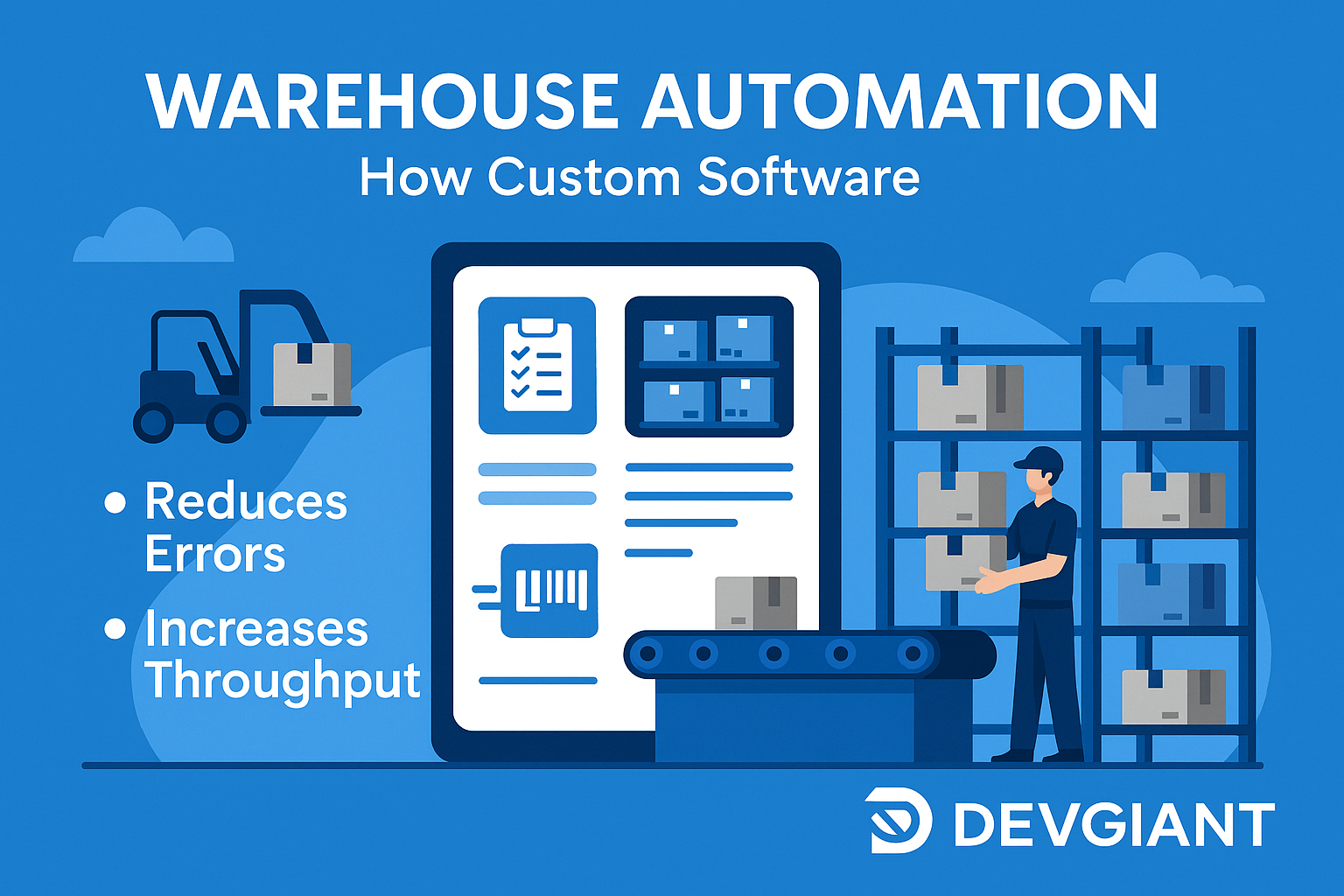
Warehouse Automation: How Custom Software Reduces Errors & Increases Throughput in 2026
Introduction
Warehouses today operate under intense pressure. Customer expectations for faster delivery, higher order accuracy, and real-time visibility continue to rise, while labor shortages and operational inefficiencies challenge even the most established supply chain organizations. Traditional workflows built on manual data entry, paper-based processes, and disconnected systems are no longer sustainable.
In 2026, companies are increasingly turning to warehouse automation driven by custom software solutions. Unlike off-the-shelf WMS platforms that force warehouses to adapt to generic workflows, custom systems allow businesses to build automation around their unique processes, infrastructure, and operational constraints. The result is greater accuracy, higher throughput, and a measurable improvement in overall performance.
Eliminating Human Error Through Automated Data Capture
Human error remains one of the costliest problems in warehouses. Miscounts, incorrect picks, and inaccurate inventory records create downstream issues such as delayed shipments, stockouts, and customer dissatisfaction. Automation begins by removing manual data entry from critical workflows.
Custom-built mobile applications, scanning systems, and IoT-connected devices ensure that every movement of goods is captured instantly and accurately. Workers scan items, bins, and pallets to update inventory levels in real time, ensuring the central system reflects the exact state of the warehouse at any moment. When integrated with SAP or another ERP, data flows reliably across departments without duplication or inconsistencies.
By replacing human-dependent steps with structured digital workflows, warehouses significantly reduce discrepancies and improve order accuracy.
Accelerating Throughput With Workflow Optimization
Throughput is a measure of how efficiently a warehouse processes incoming and outgoing goods. When processes are manual or fragmented, throughput drops, causing bottlenecks and slower order fulfillment.
Custom software automates high-impact workflows such as receiving, putaway, picking, packing, replenishment, and shipping. Automation ensures that tasks are prioritized correctly, workers receive clear instructions, and materials move through the facility without unnecessary delays.
For example, picking routes can be optimized dynamically based on order volume and warehouse layout. Tasks can be auto-assigned based on worker availability and skill level. Packing and shipping stations can be synchronized so orders flow smoothly from one step to the next.
The result is a warehouse that operates with precision, consistency, and speed — even during peak demand periods.
Enhancing Visibility Across the Warehouse Environment
Operational visibility is essential for warehouse performance. Managers often struggle to make informed decisions when they lack real-time insight into inventory levels, order progress, and worker productivity.
Custom dashboards solve this problem by consolidating all warehouse data into a single, easy-to-understand interface. Executives can view performance metrics, supervisors can monitor active tasks, and warehouse staff can see what work lies ahead. This creates a shared understanding of priorities and prevents communication breakdowns.
When integrated with IoT sensors, software can also track equipment usage, monitor environmental conditions, and identify inefficiencies such as congestion points or idle time.
Visibility transforms warehouse management from reaction-based decision-making into proactive operational planning.
Improving Space Utilization and Layout Efficiency
Warehouses often struggle to maximize space due to outdated layouts or inefficient storage practices. Custom software can simulate warehouse flow, analyze storage density, and recommend optimized layouts based on real operational data.
These insights help warehouses redesign shelving, adjust bin configurations, and refine pick paths to reduce travel time and improve capacity. Unlike generic WMS tools, custom platforms incorporate the exact dimensions, constraints, and characteristics of the facility, ensuring recommendations align with real-world conditions.
Better space utilization directly supports higher throughput and smoother operations.
Reducing Training Time Through Intuitive Digital Tools
High employee turnover is common in warehouse environments, making training a recurring challenge. Complex systems require weeks of onboarding, slowing operations and increasing the risk of errors.
Custom warehouse applications are intuitive by design, built specifically for the workflows and equipment used on-site. This reduces training time significantly and enables new employees to become productive much faster. Clear visual instructions, step-by-step guidance, and validation checks ensure workers complete tasks correctly from day one.
By simplifying the user experience, custom software supports a more agile and resilient workforce.
Connecting the Warehouse to the Enterprise Ecosystem
Automation is most effective when warehouses are fully connected to the broader enterprise system. Custom software bridges the gap between warehouse operations and platforms such as SAP, ERP tools, transportation systems, eCommerce platforms, and supplier systems.
This integration eliminates delays caused by manual data transfers and ensures that every department — from procurement to sales — has access to accurate, up-to-date information. Order statuses, inventory levels, and shipping updates become transparent across the organization, improving collaboration and reducing friction.
Why Custom Software Delivers a Stronger ROI Than Off-the-Shelf WMS Systems
While off-the-shelf warehouse management systems offer a wide range of features, they often require warehouses to modify their processes to fit the system’s structure. This can lead to inefficiencies, unnecessary complexity, and long-term limitations.
Custom solutions, on the other hand, are built around the warehouse’s existing workflows. They integrate with legacy systems, allow continuous enhancement, and evolve as the business grows. This flexibility provides a higher long-term return on investment and ensures the system remains aligned with real operational needs.
For companies using SAP, custom middleware solutions offer a practical way to extend ERP capabilities without modifying the core system, reducing risk while increasing functionality.
How DevGiant Helps Build Automated Warehouses
DevGiant partners with manufacturers, distributors, and logistics companies to build tailored warehouse automation systems. Our solutions include inventory management platforms, mobile scanning applications, real-time dashboards, middleware integrations for SAP, and fully customized workflow engines.
With expertise in industrial software and operational technology, DevGiant enables warehouses to modernize their environments, increase throughput, and reduce operational costs — all through scalable and efficient digital solutions.
Conclusion
Warehouse automation is becoming a necessary investment for companies facing rising demand, tighter fulfillment windows, and increasing pressure for accuracy. Custom software serves as the foundation for these automated workflows by connecting people, processes, and systems into a unified operational ecosystem.
Organizations that embrace custom-built warehouse solutions in 2026 will benefit from higher throughput, fewer errors, improved visibility, and a more efficient workforce — positioning themselves for long-term competitiveness in a rapidly evolving supply chain landscape.