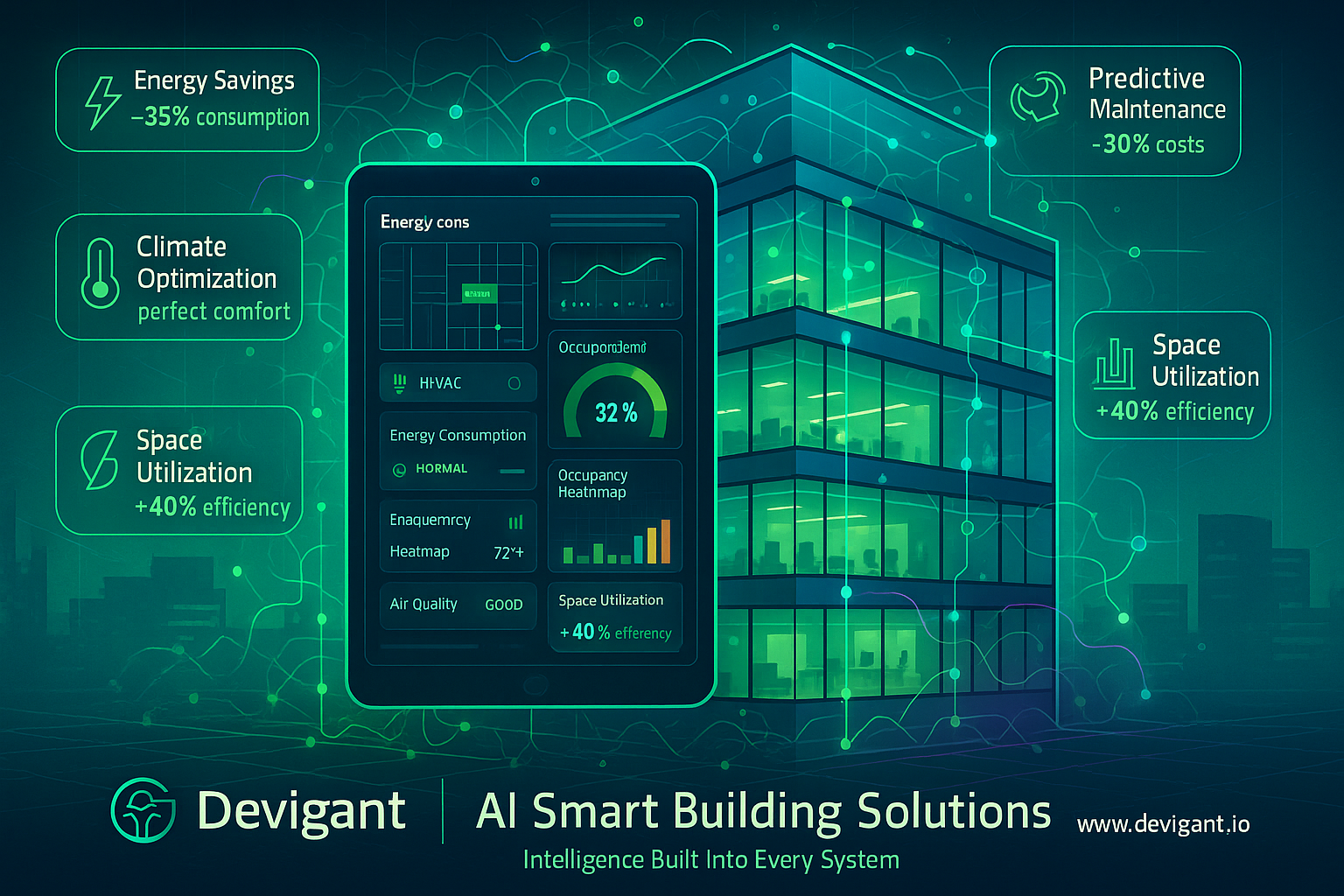
Smart Buildings Powered by AI and IoT
Modern buildings are evolving from passive structures into intelligent ecosystems that sense, learn, and respond to their environment and occupants. By combining artificial intelligence with Internet of Things sensor networks, smart buildings optimize everything from energy consumption to space utilization while creating superior experiences for occupants. This convergence of technologies is transforming commercial real estate, delivering measurable improvements in operational efficiency, sustainability, and occupant satisfaction.
The IoT Foundation: Sensors Everywhere
Smart buildings deploy thousands of sensors that continuously monitor conditions and activities. Temperature and humidity sensors track climate in every zone. Occupancy sensors detect presence and movement patterns. Air quality monitors measure CO2, particulates, and volatile organic compounds. Energy meters track consumption at granular levels. Water flow sensors identify leaks instantly. Vibration sensors on mechanical equipment detect anomalies. Light sensors optimize natural and artificial illumination. This sensor network creates a comprehensive real-time picture of building operations impossible to achieve through manual monitoring.
AI as the Building's Brain
While IoT sensors provide data, artificial intelligence transforms that data into actionable intelligence. Machine learning algorithms analyze sensor streams to identify patterns, predict problems, and optimize operations autonomously. AI systems learn each building's unique characteristics, understanding how it responds to weather changes, occupancy fluctuations, and equipment conditions. Unlike rule-based automation, AI continuously improves its decision-making, adapting to changing conditions and learning from outcomes. This creates buildings that become smarter over time rather than remaining static.
Intelligent HVAC Optimization
Heating, ventilation, and air conditioning typically account for 40% of commercial building energy use. AI-powered HVAC systems reduce this dramatically while improving comfort. By analyzing occupancy patterns, weather forecasts, thermal mass properties, and historical performance data, AI determines optimal temperature and airflow for each zone throughout the day. Systems precool or preheat spaces before occupancy, reduce conditioning in vacant areas, and adjust based on outdoor temperature trends. This intelligence typically reduces HVAC energy consumption by 25-35% while eliminating hot and cold spots that plague traditional systems.
Predictive Maintenance Revolution
Traditional maintenance follows fixed schedules, replacing components based on time rather than condition, leading to premature replacements or unexpected failures. AI analyzes sensor data from pumps, chillers, boilers, elevators, and other equipment to predict failures weeks in advance. Vibration patterns, temperature variations, power consumption changes, and performance degradation trigger maintenance alerts before problems escalate. This approach extends equipment life by 20-40%, reduces maintenance costs by 30%, and virtually eliminates disruptive emergency repairs. Building managers transition from reactive firefighting to planned, strategic maintenance.
Dynamic Lighting Management
AI-controlled lighting systems balance natural daylight with artificial illumination, adjusting throughout the day based on available sunlight, occupancy, and task requirements. In perimeter zones, systems dim or brighten fixtures as cloud cover changes. In meeting rooms, lighting adapts to presentations or collaborative work. In warehouses, lights illuminate only occupied aisles. This intelligence reduces lighting energy consumption by 60-80% compared to traditional systems while enhancing visual comfort and supporting circadian health through tunable white spectrum control.
Space Utilization Intelligence
IoT sensors track how building spaces are actually used versus designed capacity. AI analyzes this data to reveal underutilized conference rooms, overcrowded common areas, and inefficient workspace allocation. Real-time occupancy information helps employees find available spaces instantly through mobile apps. Long-term patterns inform strategic decisions about space reconfiguration, sublease opportunities, or expansion needs. Organizations discover they often need 30-40% less space than they thought, or can reorganize existing space to support more employees without expanding.
Enhanced Indoor Air Quality
Post-pandemic awareness has elevated indoor air quality from afterthought to priority. Smart buildings continuously monitor air quality and adjust ventilation rates accordingly. When CO2 levels rise in occupied spaces, AI increases fresh air intake automatically. If outdoor air quality deteriorates due to pollution or wildfires, systems shift to recirculation mode with enhanced filtration. Advanced systems even adjust to occupant activity levels—increasing ventilation during intense meetings or workout sessions. This creates healthier environments while optimizing energy use, as ventilation becomes responsive rather than constant.
Intelligent Security and Access
AI-powered security systems move beyond basic card readers and cameras. Computer vision analyzes video feeds in real-time, detecting unusual behavior, unauthorized access attempts, or safety hazards like spills or obstructions. Facial recognition enables frictionless entry for authorized personnel while flagging unknown individuals. AI correlates access data with occupancy patterns to identify anomalies—someone accessing the building at unusual hours or entering restricted areas. Integration with building systems allows security protocols like lockdowns to execute automatically when threats are detected.
Energy Demand Response
Utility companies increasingly offer demand response programs that pay buildings to reduce consumption during peak periods. AI enables buildings to participate automatically and optimally. Systems forecast which loads can be shed without occupant impact, pre-cool spaces before demand response events, shift energy-intensive operations to off-peak hours, and manage on-site energy storage for maximum economic benefit. Buildings become active participants in the energy grid, generating revenue while supporting grid stability. Participants often reduce utility costs by 15-25% through these programs alone.
Occupant Experience Personalization
Advanced smart buildings offer personalized environments through mobile apps or wearables. Employees preset temperature, lighting, and desk height preferences that follow them between workspaces. AI learns individual preferences over time, making proactive adjustments. Digital assistants guide visitors to meeting rooms, notify hosts of arrivals, and provide wayfinding through complex buildings. Systems remember regular visitors' preferences, creating hotel-like personalization in office environments. This individual-level control significantly enhances satisfaction and productivity.
Integration and Interoperability
Effective smart buildings integrate historically siloed systems—HVAC, lighting, security, fire safety, elevators—into unified platforms. AI orchestrates these systems holistically rather than optimizing each independently. When a fire alarm triggers, AI simultaneously controls elevators, door locks, lighting, and PA systems. During office parties, security and HVAC systems coordinate to manage after-hours access and environmental loads. This integration requires open protocols and APIs that allow different systems to communicate seamlessly.
Data Analytics and Insights
Beyond real-time operations, smart buildings generate valuable longitudinal data for strategic decisions. AI identifies which building features employees use most, when conference room demand peaks, how occupancy patterns have shifted post-pandemic, and which spaces foster collaboration versus focus work. Portfolio managers compare performance across buildings, identifying best practices and underperformers. This intelligence informs renovation priorities, tenant amenity decisions, and acquisition strategies with precision impossible through surveys or intuition alone.
Sustainability and ESG Reporting
Corporate sustainability commitments and regulatory requirements demand accurate environmental reporting. Smart buildings automatically track energy consumption, water usage, waste generation, and carbon emissions with granular detail. AI calculates metrics like Energy Use Intensity and carbon footprint, comparing performance to targets and industry benchmarks. Automated reporting satisfies LEED, BREEAM, WELL, and other certification requirements without manual data collection. This transparency helps organizations meet ESG commitments and communicate environmental performance to stakeholders.
Return on Investment
Smart building investments deliver compelling returns through multiple channels. Energy savings alone often provide 3-5 year payback periods. Reduced maintenance costs accelerate returns further. Improved space utilization can eliminate expansion costs or generate sublease income. Premium tenants increasingly demand smart building features, supporting rent premiums and reducing vacancy. Studies show smart buildings command 7-10% higher rents and sell at 15-20% premiums to conventional properties. Operating expense reductions of 30-40% are common, dramatically improving net operating income.
Implementation Challenges
Retrofitting existing buildings presents challenges including legacy systems incompatible with modern protocols, physical limitations on sensor installation, and tenant concerns about privacy. Successful implementations start with thorough assessments identifying high-value opportunities with manageable complexity. Phased approaches prove more successful than attempting comprehensive transformation immediately. Change management that addresses occupant concerns and demonstrates benefits builds essential buy-in. Selecting vendors with proven integration capabilities prevents technology dead ends.
The Future of Smart Buildings
Emerging technologies will enhance smart building capabilities further. Digital twins create virtual replicas where AI simulates scenarios before implementing changes in the physical building. Edge computing enables faster processing and greater privacy by analyzing data locally rather than in the cloud. 5G connectivity supports dense sensor networks and bandwidth-intensive applications. Blockchain could enable secure, automated transactions between buildings and energy providers. Eventually, smart buildings may negotiate energy purchases, schedule their own maintenance, and optimize operations with minimal human oversight.
Conclusion
Smart buildings powered by AI and IoT represent the future of commercial real estate. These technologies deliver measurable improvements in energy efficiency, operational costs, occupant satisfaction, and environmental performance. As sensors become cheaper, AI more sophisticated, and integration more seamless, smart building capabilities will expand to encompass functions we cannot yet imagine. Building owners and operators who embrace this transformation position themselves at the industry's leading edge, while those who delay risk managing increasingly obsolete assets in a market that values intelligence and efficiency above all.