How AI Predicts Property Prices and Market Trends
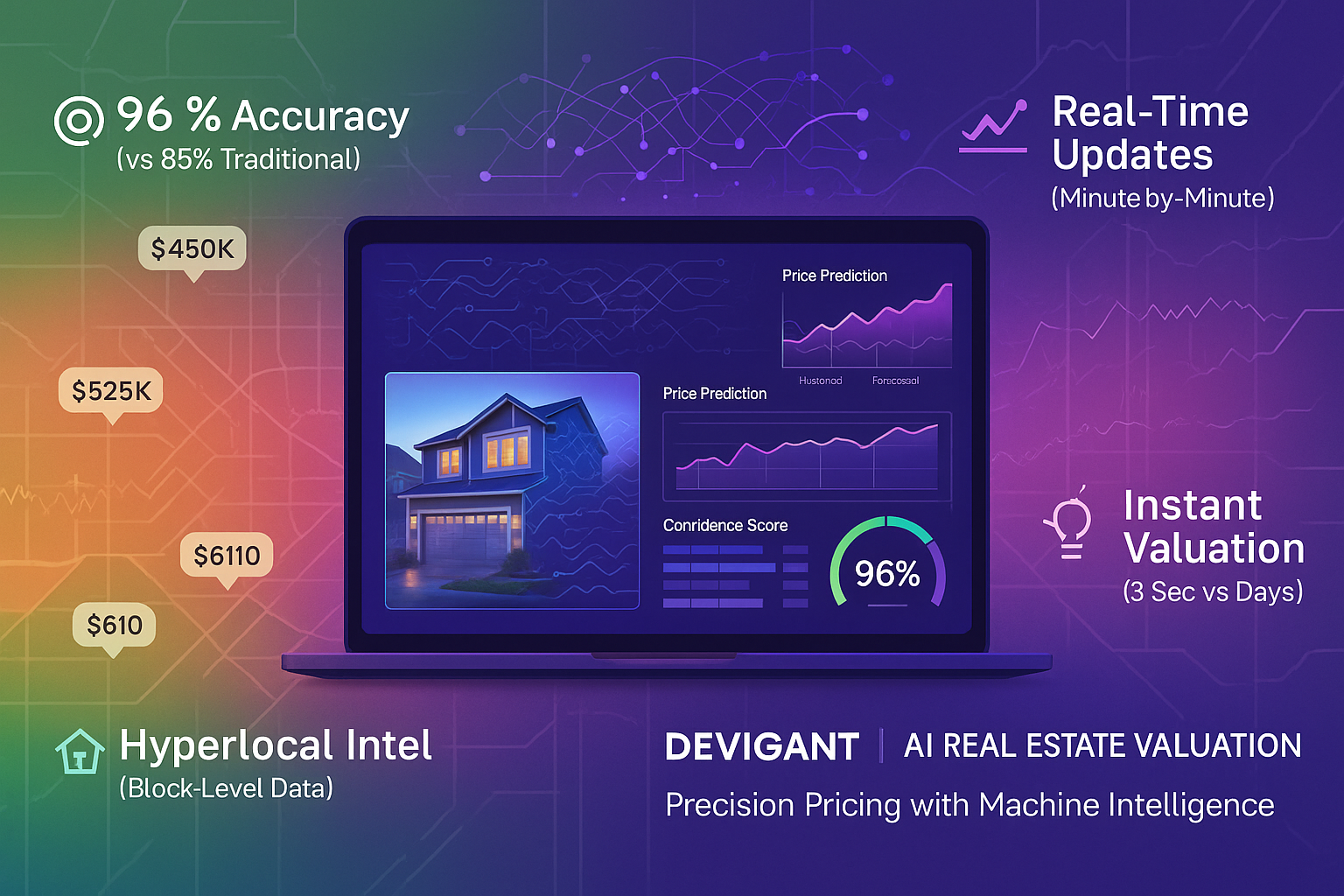
Traditional property valuation methods rely on comparative market analysis and appraiser expertise, processes that can take days or weeks and vary significantly between professionals. Artificial intelligence is revolutionizing this landscape, analyzing millions of data points in seconds to predict property values with remarkable accuracy. Modern AI valuation models routinely achieve accuracy rates exceeding 95%, transforming how buyers, sellers, investors, and lenders assess real estate value.
The Data Foundation of AI Property Valuation
AI property prediction models ingest vast datasets that human appraisers simply cannot process at scale. These include historical sales data spanning decades, current listing prices, property characteristics like square footage and bedroom count, lot size, age, and condition ratings. Beyond basic features, AI models incorporate neighborhood crime statistics, school quality ratings, proximity to amenities, transportation access, environmental factors, and even walkability scores. Economic indicators such as employment rates, income levels, population growth, and local business development feed into sophisticated algorithms that understand market dynamics at granular levels.
Machine Learning Algorithms in Property Valuation
Several AI approaches power modern property price prediction. Regression models establish relationships between property features and sale prices, learning which characteristics most influence value. Neural networks create complex, multi-layered models that identify non-linear patterns humans might miss, excelling at capturing subtle market nuances. Gradient boosting machines combine multiple weak predictive models into powerful ensemble systems, often achieving the highest accuracy in real estate applications. Deep learning models process unstructured data like property photos, satellite imagery, and street views to assess condition, curb appeal, and neighborhood quality automatically.
How AI Analyzes Market Trends
AI systems monitor real estate markets continuously, identifying emerging trends before they become obvious. Time series analysis tracks price movements over months and years, detecting seasonal patterns and long-term trajectories. Sentiment analysis scans news articles, social media, and economic reports to gauge market psychology and future demand. Network analysis examines how price changes propagate through neighborhoods, predicting which areas will appreciate next based on spillover effects from nearby development. AI recognizes when markets transition from buyer to seller conditions and vice versa, providing early signals for strategic decision-making.
Comparative Market Analysis Reimagined
While traditional appraisers compare a property to three to five similar recent sales, AI can instantly analyze thousands of comparable properties, weighing each according to similarity across dozens of dimensions. Machine learning determines which features matter most in specific submarkets—perhaps lot size dominates value in suburban areas while walkability drives urban pricing. AI adjusts for market time, recognizing that comparables from six months ago need temporal correction in fast-moving markets. The result is valuation that captures local market dynamics with precision impossible through manual analysis.
Hyperlocal Neighborhood Intelligence
AI creates detailed neighborhood profiles extending far beyond basic demographics. Computer vision analyzes street view imagery to assess neighborhood maintenance, architectural style consistency, and commercial vitality. Foot traffic data from mobile devices reveals actual area popularity versus perception. Environmental sensors track noise levels, air quality, and even sunlight patterns. Social network analysis identifies emerging desirable neighborhoods by tracking where influencers and early adopters move. This granular understanding allows AI to predict which blocks within neighborhoods will outperform or underperform area averages.
Economic and Policy Impact Modeling
Sophisticated AI systems incorporate macroeconomic factors and policy changes into property predictions. Interest rate movements, mortgage availability, tax policy shifts, and zoning changes all influence property values. AI models simulate how these factors ripple through markets, predicting impacts on different property types and locations. When cities announce infrastructure projects or zoning changes, AI immediately recalculates affected property values, giving investors actionable intelligence sometimes years before impacts fully materialize.
Real-Time Valuation Updates
Unlike traditional appraisals that represent point-in-time assessments, AI valuations update continuously as new data arrives. Every property sale, listing price change, economic report, and policy announcement refines model predictions. This dynamic approach means property values stay current in fast-moving markets, particularly valuable for investors managing portfolios or lenders monitoring collateral values. Real-time valuation also enables instant pricing for iBuyers and instant offer programs that must quote competitive prices without lengthy appraisal processes.
Accuracy and Validation
Leading AI valuation platforms now achieve median errors below 2% for single-family homes in data-rich markets, outperforming human appraisers' typical 5-10% variance. Accuracy improves continuously as models ingest more data and learn from prediction errors. However, AI performs best in markets with abundant transaction data and struggles in rural areas or unique property types with few comparables. Hybrid approaches combining AI baseline valuations with human expert adjustment for unusual properties often deliver optimal results.
Applications Across Real Estate
Buyers use AI valuations to identify overpriced listings and make competitive offers instantly. Sellers price properties optimally from day one, reducing time on market. Investors screen hundreds of potential acquisitions daily, focusing detailed analysis only on properties where AI identifies value opportunities. Lenders automate loan approval workflows, making lending decisions in minutes rather than weeks. Tax assessors leverage AI for fair and consistent property tax assessments across thousands of properties. Insurance companies price policies based on AI-predicted replacement costs and risk factors.
The Future of AI Property Prediction
Emerging AI capabilities promise even greater accuracy and insight. Natural language processing will extract value signals from property descriptions, inspection reports, and even seller motivations. Augmented reality combined with AI will enable instant valuations by simply pointing a smartphone at a property. Quantum computing may eventually power simulations of entire real estate markets, modeling millions of properties and scenarios simultaneously. AI agents might negotiate property transactions autonomously, finding optimal pricing through game-theoretic approaches.
Limitations and Considerations
Despite impressive capabilities, AI valuations have limitations. Models trained on historical data can perpetuate past biases, requiring careful fairness monitoring. Unusual properties, major renovations, or rapidly gentrifying neighborhoods can confound algorithms trained on historical patterns. AI cannot yet fully assess subjective factors like architectural beauty or emotional appeal that influence what buyers will actually pay. The most effective approach combines AI's data processing power with human judgment for nuanced situations.
Conclusion
AI has transformed property valuation from an art relying heavily on individual expertise to a science grounded in comprehensive data analysis. These systems process information at scales impossible for humans, identifying patterns and trends that inform better buying, selling, and investing decisions. As AI continues advancing, property valuation will become faster, more accurate, and more accessible, democratizing real estate intelligence that was once available only to large institutional players. The future of real estate markets will be shaped increasingly by algorithms that see patterns invisible to human observers.